


Amesect:
Revolutionising Waste Management and Sustainable Feed Production in Africa with Black Soldier Fly Technology
By Elodie Ashdown, VUKA Group

CAPE TOWN, South Africa – In a recent interview with Elodie Ashdown, Investment Project Lead at VUKA Group, Dave Stewart, business development director of Amesect (Pty) Ltd, shed light on his company’s groundbreaking approach to transforming organic waste into high-value bioproducts. Amesect is disrupting the Black Soldier Fly (BSF) agriculture sector in South Africa, by offering a biotechnology that allows a practical and simple way to use black soldier flies to create onsite value for organic waste producers, addressing critical challenges in waste management, feed scarcity, and climate resilience across the continent.
“We are turning an environmental liability into a valuable resource,” Mr. Stewart stated, encapsulating Amesect’s core mission. “Our technology provides a sustainable pathway for South Africa to manage its organic waste crisis while simultaneously producing valuable bioproducts for feed soil health, and industry.”

The urgent need for circular solutions in Africa
Africa, like much of the world, faces a growing “polycrisis” characterised by climate instability, ecosystem pressures, and geopolitical tensions, which threaten already fragile food and feed supply chains. A significant portion of organic waste ends up in landfills, contributing to greenhouse gas emissions and wasting valuable biological nutrients. As highlighted in the GreenCape “Black Soldier Fly Agriculture” industry brief, approximately 45% of South Africa’s 22.8 million tonnes of edible food is never consumed, creating a profound wastage issue. This linear “take-make-waste” economy exacerbates resource scarcity and environmental degradation.
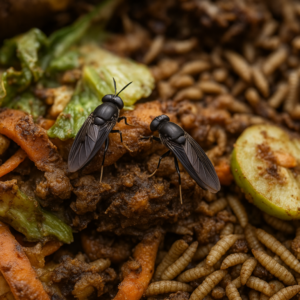
Black Soldier Flies (BSF) offer a compelling circular economy solution. In natural ecosystems, BSF larvae act as highly efficient waste processors, converting organic material into body mass and nutrient-rich excrement, thereby cycling vital nutrients back into the ecosystem indefinitely. This biological process is proving to be a game-changer for waste management and sustainable protein production. It’s important to note that BSF is not regarded as an invasive species in South Africa and poses no risk to local ecosystems.
|
|
 |
 |
Amesect’s Innovative “MAGIC³” Technology
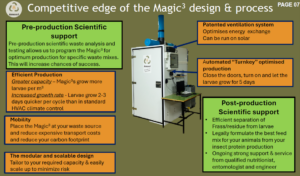
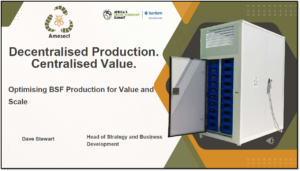
At the heart of Amesect’s solution is its proprietary “MAGIC³” (Mobile Automated Grow-Insect Climate-Control Chamber) technology. This decentralised organic-waste-to-bioproduct system represents a significant advancement in BSF agriculture, particularly for the African context.
Designed for African conditions, MAGIC³ is a modular, decentralised, climate-controlled processing system that converts organic waste into high-value ingredients where the waste arises.
“Traditional BSF systems struggle ranging from rudimentary greenhouses with climate variability to traditionally climate-controlled containers, face inconsistent waste streams, and high operational cost and inefficiencies in energy and yield” Stewart explained. “MAGIC³ solves this through careful waste pre-processing and analysis coupled with environmental control, automation, and modularity—unlocking consistent production and high-value outputs.”
The system is currently validating on-site larvae production across multiple waste streams—including food waste, stillage, abattoir waste, agricultural residues, and brewery side-streams.
High-Value Bioproducts
Each MAGIC³ unit produces four commercial outputs:
● Insect Protein Meal: A sustainable alternative to fishmeal and soy, offering high digestibility and reduced environmental footprint.
● Insect Oil: Suitable for poultry and aquafeed and industrial formulations—reducing pressure on palm, coconut, and wild fish oils.
● Frass: A nutrient-rich soil conditioner and bio-stimulant that improves soil carbon, water retention, and crop resilience.
● Chitin Chitosan: Amesect has developed a process to convert chitin to chitosan, a high-value biopolymer with applications in:
➔ Pharmaceuticals
➔ Cosmetics
➔ Agriculture
➔ Bioplastics
By acting as a keystone technology within Africa’s emerging circular economy, MAGIC³ transforms waste into economic opportunity while delivering measurable environmental and social impact at scale.
Key environmental benefits:
● Diverts significant volumes of organic waste from landfills, eliminating methane generation at the source
● Avoids ~670 tonnes of CO₂-e per per Major MAGIC³ unit annually (equivalent of removing 145 cars from the road per year)
● Prevents water pollution by stopping leachate formation and capturing clean process water
● Supports climate-smart waste management aligned with national and municipal sustainability goals
● Regenerates ecosystems by returning nutrients to soils through frass biostimulant products
Key socio-economic contributions:
● Creates local employment in waste management, farming, processing, logistics, and biotechnology
● Drives a decentralised circular economy, allowing waste producers to convert their own organic waste into local economic value
● Reduces reliance on imported and volatile feed ingredients such as fishmeal, soymeal, palm oil, and coconut oil
● Strengthens food system resilience across livestock, aquaculture, and pet food sectors
● Opens access to high-growth global markets, with the BSF sector projected to reach $3.96 billion by 2033
● Enables new rural and peri-urban micro-enterprises through the hub-and-spoke MAGIC³ network
Forging Ahead: Partnerships & Scaling
Since receiving a £200,000 investment, Amesect has made substantial progress in developing its BSF technology. The company has forged key partnerships, including with the South African Circular Agricultural Initiative and Life AgriScience, aiming to establish a circular agricultural economy research hub in Stellenbosch. This collaboration is crucial for ongoing R&D, focusing on optimizing larvae production, refining high-value byproducts like fish feed and chitosan and synergies with other circular economy practices such as fish farming. Amesect is also actively exploring collaborations with various organizations to address broader waste management challenges.
Mr. Stewart acknowledged this, affirming Amesect’s commitment to enhancing their communication.
“We are committed to refining our pitch to clearly articulate the wide-ranging impact of our BSF solutions, from agriculture and industry to public health,” he stated. He indicated that a product demo video and a new website have been launched to strengthen their online presence and market messaging. Both parties agreed on the importance of ongoing engagement and post-event follow-up to maintain investor interest, with Mr. Stewart committing to provide updated documentation and materials to support these efforts. This approach aims to build investor confidence by showcasing the extensive market reach and diverse applications of BSF technology.

Scaling Up for a Sustainable Future
Amesect, now operating a second generation prototype plant, is at a pivotal stage, actively seeking strategic investment to scale up its production and develop a semi-decentralised high value production plant. Mr. Stewart articulated this need: “We need to scale up now, bringing more plants online to meet the growing demand for our products and the urgent need for sustainable waste management solutions across Africa.” This expansion will allow Amesect to move from validating field production to establishing a semi-decentralised processing facility, enabling large-scale harvesting and processing of larvae from a network of decentralized MAGIC³ producers.
This hub-and-spoke model will bridge field operations with centralised value creation, unlocking access to high-value biopolymer markets.
The company is seeking R51.5 million to establish this pilot semi-decentralised facility, expand MAGIC³ deployments, and validate this scalable model. Amesect represents a commercially viable, climate-smart solution to Africa’s organic waste challenge, transforming waste liabilities into profitable, high-value bioproducts while delivering measurable environmental and social impact.
See the Decentralised Production; Centralised Value Investment Proposal for more information.
About Amesect
Aquaculture Solutions is a specialist aquaculture and aquaponics design and implementation company with projects across Africa and selected international markets. The company offers feasibility studies, system design, construction support, training and operational advisory services.
Contact Details:
For more information about Amesect and Black Soldier Fly (BSF) agriculture, please contact Dave Stewart at:
Mobile/WhatsApp: +27 73 552 1613
Email: dave@amesect.co.za
www.amesect.co.za
