


Scaling Commercial Wheat Production in Africa:
A Strategic Opportunity


Wheat Production in Africa: The Current Landscape
Wheat has become one of Africa’s most important staple crops, particularly in urban and peri-urban markets where bread, pasta and other wheat-based foods dominate daily diets. Yet, Africa’s wheat production continues to lag far behind consumption, creating a structural dependency on imports.
Africa currently produces an estimated 25–28 million tonnes of wheat annually, grown on approximately 10 million hectares. This represents only a small fraction of global wheat output, despite rising local demand. Production is highly concentrated, with a few countries accounting for the bulk of supply:
-
Egypt: ~9.5–9.7 million tonnes
-
Ethiopia: ~7–7.5 million tonnes
-
Algeria, Morocco and South Africa: each ~2–3+ million tonnes
 Outside these countries, wheat production across much of sub-Saharan Africa remains limited, fragmented and dominated by smallholder systems.
A Growing Import Gap
Domestic production is insufficient to meet demand.
-
Sub-Saharan Africa imports more than 30 million tonnes of wheat annually, a figure that continues to rise.
-
Major importers include Nigeria, Kenya, Sudan and South Africa.
-
Many African countries rely on wheat imports for 60–90% of domestic consumption, exposing them to global price volatility, currency risk and supply disruptions.
This growing production-import gap represents both a strategic vulnerability and a clear development opportunity.
Wheat Yields Tell the Real Story
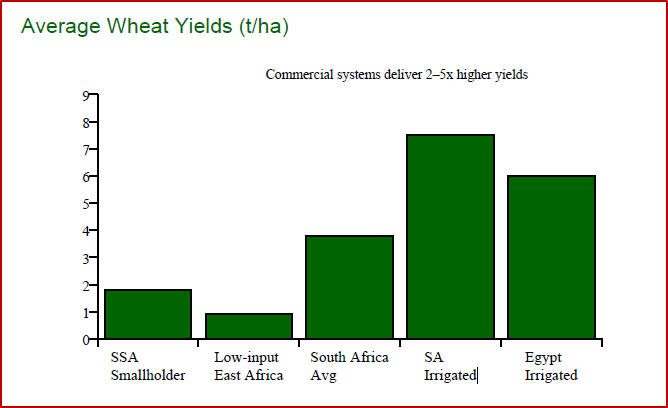
While total production volumes are important, yield per hectare is one of the clearest indicators of why Africa struggles to close the wheat deficit — and why commercial-scale farming systems matter.
Average Wheat Yields in Africa (t/ha)
Across much of Africa, especially in smallholder-dominated systems, wheat yields remain well below global and commercial benchmarks:
| Country / Region | Average Yield (t/ha) | Production System |
|---|---|---|
| Smallholder systems (SSA average) | ~1.5–2.0 | Rainfed, low mechanisation |
| Low-input pockets (East Africa) | <1.0 | Resource-constrained |
| South Africa (national average) | ~3.7–3.9 | Commercial, mechanised |
| South Africa (irrigated commercial fields) | 7.0–8.0+ | Intensive commercial systems |
| Egypt | ~6.0 | Irrigated, high-input |
What the Numbers Show
-
Typical smallholder wheat yields in sub-Saharan Africa are 2–4 times lower than those achieved on South African commercial farms.
-
Compared with irrigated commercial systems, the yield gap can exceed 5–8 times.
-
These differences are not driven by genetics alone, but by scale, management, mechanisation, input access, irrigation, finance and market integration.
The conclusion is clear:
Africa’s wheat challenge is not simply about growing more wheat — it is about producing wheat commercially, at scale, and competitively.
The Opportunity: Scaling Commercial Wheat Production
Expanding commercial wheat farming systems presents a powerful opportunity to:
-
Reduce import dependency and protect foreign exchange reserves
-
Improve food security through stable local supply
-
Create rural employment across production, logistics and processing
-
Strengthen value chains, including milling and food manufacturing
-
Introduce climate-smart, high-yield systems suited to African conditions
Recent initiatives — such as high-yield, climate-adapted wheat programs in West and East Africa — demonstrate that wheat can perform well when supported by the right production model.
Why Africa Needs Implementation Partners — Not Just Policy
Despite strong potential, scaling commercial wheat production faces persistent constraints:
-
Fragmented landholdings
-
Limited access to mechanisation and irrigation
-
Weak storage, logistics and processing infrastructure
-
Insufficient project preparation and bankable business models
-
Financing gaps for large-scale farming enterprises
Overcoming these challenges requires end-to-end agribusiness development expertise, capable of moving from strategy to execution.
The ADC: A Proven Partner for Commercial Wheat Development
The Agribusiness Development Corporation (ADC) is uniquely positioned to support African governments, development institutions and investors in building competitive commercial wheat sectors.
Why ADC Is the Partner of Choice
Commercial Agribusiness Expertise
ADC specialises in designing and implementing large-scale, market-driven agricultural projects aligned with African realities.
End-to-End Value Chain Delivery
From feasibility studies and business models to financing, production systems, infrastructure and market access — ADC manages the entire wheat value chain.
Pan-African Experience
ADC has successfully delivered agribusiness projects across multiple African countries, navigating diverse agro-ecological, policy and investment environments.
Public-Private Partnership Capability
ADC brings together governments, DFIs, private investors and technology partners to create bankable, scalable wheat initiatives.
Data-Driven, Results-Focused
ADC’s approach is grounded in performance benchmarks — including yield improvement, cost efficiency and commercial viability — ensuring measurable impact.
We will bring the commercial farming know-how and experience to develop commercial crop & animal production, processing and marketing projects along the entire agribusiness value chain. This can be done for both green and brownfield developments from business plan stages, through the mobilisation of finance and market linkage, to project implementation and management.

Conclusion: Turning Yield Gaps into Growth
Africa’s wheat deficit is not inevitable. The yield data clearly shows that commercial-scale production systems work — and that closing the productivity gap can dramatically reduce import dependence.
What is needed now is strategic implementation at scale, backed by partners who understand both agriculture and agribusiness.
The Agribusiness Development Corporation (ADC) stands ready to partner with countries and organisations across Africa to transform wheat from a costly import into a locally produced, commercially viable growth engine.
Engage the ADC to explore commercial wheat development partnerships and unlock Africa’s wheat potential — at scale, sustainably, and competitively.
We have specific expertise in the design, implementation and management of large scale grain production projects and look forward to the opportunity to assist African countries and companies to expand commercial wheat production!

Contact details:

If you have any questions regarding the ADC, our products/services and working with us, please contact Hennie van der Merwe:
Mobile/WhatsApp no:+27 83 655 4055
Email: agribusiness@iafrica.com
To list your business email – marketing@agri4africa.com
For products or equipment queries email – info@agri4africa.com
For events email – marketing@agri4africa.com
