
A company specialising in the design and construction of economically viabile, environmentally sound and aesthetically pleasing fish farms and aquaponics systems.
Processes in nature typically have a circular flow so that the by-products of one process become the inputs of the next. This maximizes efficiencies and minimises wastes, inspiring the approach to our designs and builds at Aquaculture Solutions. We promote technologies that feed people, in a manner that is environmentally gentle and financially viable. These processes include aquaponics and the intensive farming of fish.

Services we offer include the following:
Are you considering an investment in fish farming or aquaponics? Aquaculture Solutions can support you through the entire process from concept to commercial reality. The process via which we support Clients is as follows:
1. Concept Development
This is the first level of contact between Aquaculture Solutions and the Client, who is usually the Investor or represents the Investor. It seeks to understand the Client’s desired outcomes in terms of which species is to be farmed, the proposed infrastructure type, whether aquaponics will be included, the site where the infrastructure is to erected, the time frame according to which this development is expected to occur, the scale of the operation, where the products will be marketed, any other relevant information and the services that the investor wishes to receive from Aquaculture Solutions. If needed, Aquaculture Solutions can assist the Client with the Concept Development. The purpose of this help would be to list and clarify any elements the Client may not have considered and which would complement and improve the envisaged plan.
An understanding of the Concept enables Aquaculture Solutions to best advise the Client in terms of the services and steps that can be offered to take the Concept to reality. Ideally, Aquaculture Solutions works alongside the Client in the role of Implementation Partner to provide a turn-key solution from concept, through scoping, feasibility, design, costing and construction, to training and mentorship.
There is usually no charge for the involvement of Aquaculture Solutions in this first level of contact as the exchange normally amounts to no more than a few emails and possibly a telephone call. The outcome at the Concept Development stage is a very high-level idea of what species and/or crop to produce, how, where, using which infrastructure and for which market.
2. Scoping Study
The first formal engagement between Aquaculture Solutions and the Client is usually a trip to the proposed site. This provides an opportunity for Aquaculture Solutions to meet the Client in person at the proposed site, refine any outstanding aspects of the Concept Development, and assess the proposed site or sites. The visit to the site establishes the suitability of the site for the species, infrastructure and scale of operation, and confirms whether the site is suited to the Concept or not.
If a water quality analysis has not yet been completed then the proposed water source/s should be tested at this point. This is usually undertaken by the Client based on Aquaculture Solutions’ guidance in terms of which water quality parameters to measure.
Part of the Scoping Study is to assess what additional studies are required and advise the Client regarding soil samples, site contour mapping, etc. to ensure the suitability of the site and as required for the subsequent phases.
If multiple sites are being considered, Aquaculture Solutions will advise the Client on the strengths and weaknesses of each, and recommend the site that is believed to best fit the Client’s Concept.
If requested Aquaculture Solutions can provide input, but does not apply for any authorisations or permits that Clients may require.
The conclusion of the Scoping Study is a Report prepared by Aquaculture Solutions for the Client which provides the findings and recommendations relating to the Concept Plan and the site.
3. Technical & Economic Feasibility Study
Following a positive outcome from the Scoping Study, the Technical & Economic Feasibility Study stage commences. This involves high level designs generated in order to estimate the cost of the production infrastructure, as well as the associated logistic support, to produce the required quantity and quality of fish from the available site. This study usually ends at the farm gate as Aquaculture Solutions’ area of expertise is not marketing. Post-harvest processing, however, may be included if required and requested by the Client to service a proposed market.
A Cash Flow analysis forms part of the high level feasibility assessment to determine how much capital is required, in which months, when first sales occur and when the business is expected to achieve break even. The Technical and Economic Feasibility Report that is delivered to the Client at the culmination of this investigation will demonstrate whether or not the business is technically and financially viable, as well as the quantum of economic viability in terms of the Return on Investment; this will enable the client can decide to commit to further planning. Financial accuracy targets 80-85% at this stage.
4. Design with Sketches
Once a decision has been made to proceed with the investment, the design of the infrastructure can be undertaken. Aquaculture Solutions has 2 decades of experience in designing and erecting infrastructure based on sketches. This is the preferred format as it is simple, clear and cost effective. However, if the Client (or an authorising authority) requires technical drawings then Aquaculture Solutions, or the Client, can have these commissioned through an outside party at the Client’s expenses.
Stages 3 & 4 can be undertaken simultaneously if, after the Scoping Study, the Client is convinced that they will proceed with this investment. Streamlining here is ideal as the designs are then drawn up for the species at the site on which the farm is to be constructed, enabling the Bill of Quantities and ensuing Cash Flow Analysis to be as accurate as possible.
The outcome of this phase is a Report for the Client providing the sketches for all infrastructure to be used for the farming of the fish, and aquaponics if included, along with support infrastructure required on site. The Bill of Quantities is accurate for the components required and the Cash Flow is based on site specific quantities and variables. Financial precision targets >95% accuracy at this stage.
5. Construction & Commissioning
This is a critical stage and Aquaculture Solutions prides itself in providing results for the Client that are cost effective, durable and ergonomically efficient, enabling the maximum quantity of fish and crops to be produced from the investment, and therefore obtain the best possible return for the Client.
A comprehensive Aquaculture Solutions Construction Agreement will be prepared at this stage. This Agreement clarifies which Party is responsible for which components so that there is neither omission nor overlap in the services provided. Furthermore, the terms of engagement are clearly listed to avoid disagreement at a later stage.
Aquaculture Solutions will typically purchase, consolidate and containerise the equipment required for shipping to the Client’s site. Just prior to the arrival of the containers on site, Aquaculture Solutions representatives will arrive to ensure the site is ready, both to receive the containers and for construction to commence. The containers are unpacked and construction is managed by the Aquaculture Solutions team to ensure the appropriate building standards are adhered to, to ensure the erection and assemblies are correct in terms of the various component designs and to keep the entire process in line with the timeline established on the Gantt Chart.
By the conclusion of this phase the infrastructure will have been erected in accordance with the terms and design diagrams of the Construction Agreement, and handed over to the Client, usually with all equipment operating.
6. Training
Following the construction of the infrastructure, Aquaculture Solutions offers to provide training to the staff who will operate the facilities. This includes tuition in both the theoretical aspects as well as the practical components of this sort of agriculture, in order to transfer knowledge on how to operate the facilities and equipment optimally, as well as to master the various aspects relating to managing the fish, and the plant crops in the case of aquaponics.
Included in the Training Phase is the refinement of site-specific Operational Protocols which are supplied to the Client. These outline the management of the facilities and stocks, and are used as the framework according to which the training is performed.
7. Mentorship
Aquaculture Solutions can provide mentorship to the management of the facility for an agreed period following construction and training if required by the Client. Mentorship follows the onsite training of the management team conducted in step 6, and leads into monitoring of the management on site as they execute their responsibilities. Once the farm management are competent in their roles, Aquaculture Solutions can support them further via a weekly report which is compiled by management and emailed to Aquaculture Solutions in the format provided by Aquaculture Solutions. The report is studied by Aquaculture Solutions and any deviations from expectation are immediately discussed with the management via Zoom or a similar platform to understand why the deviation occurred and what was done to remedy the situation.
Aquaculture Solutions can also conduct additional ad hoc or scheduled visits to the site to assess, comment and ensure that the production and maintenance are occurring in accordance with the Operational Protocols, and to recommend changes where required to realign processes to the optimal. Trouble shooting, problem solving and the introduction of site-specific innovations can also be undertaken during Mentorship where relevant to the operation. All costs associated with these mentorship visits will be for the Clients’ account.
Aquaculture Solutions can also conduct additional ad hoc or scheduled visits to the site to assess, comment and ensure that the production and maintenance are occurring in accordance with the Standard Operational Protocols, and to recommend changes where required to realign processes to be optimal. Trouble shooting of problems and the introduction of innovations can also be undertaken during these points where relevant to the operation. These visits will be for the Clients account.
Aquaculture Solutions trusts that this document sets out for the reader the clear and logical path according to which Aquaculture Solutions prefers to support its’ clients as they consider, assess and invest in aquaculture and/or aquaponics. Would you like to discuss Aquaculture Solutions supporting you with the development of your fish farm or aquaponics development? contact us
What works and how to do it efficiently
Aquaculture Solutions offers training for prospective industry investors, or fish farmers who are aleady operational but require refresher exposure. This 5-day Course is based on experiences gained during 30 years of designing, building and operating fish farms and aquaponics systems across Southern Africa. The focus of the training is pragmatic: `what works, what does not and how to be most economically efficient‘. Furthermore, training is presented at a commercial aquaponics farm, so delegates have the opportunity to view various operational systems to unpack their advantages, limitations and best practices.
The course commences with a global, continental and regional overview of the industry to better understand the context. Thereafter we look at industry specific factors such as water quality management, health maintenance, feeding and breeding, which are relevant irrespective of the species being produced or infrastructure being utilised. Next, we consider in detail each of the primary fish species being farmed in Southern Africa so that the delegate has a thorough understanding of the species and where it is most appropriate for farming, as well as how best to produce it in the context of local climate and markets. Thereafter, we discuss each of the infrastructure options used for fish farming to understand when it is the best option, the design considerations and how the infrastructure type is managed for fish farming. This infrastructure section ends off with a detailed look at aquaponics as an economically and environmentally attractive addition to an intensive fish farm. The Course concludes by comparing stylised examples of fish and infrastructure to obtain a high-level perspective on the capital and operational costs involved, output expected and the relative profitability of each option.
People or groups who wish to receive a detailed Course Agenda or attend a Course should make contact on Email us
Aquaculture Solutions believes in recirculating technology for fish farming, for the following reasons:
|

The word aquaponics is derived from the parent industries of aquaculture and hydroponics. In aquaponics, water from fish is cycled continuously through beds or rafts in which plants are rooted. Friendly bacteria convert the ammonia released by the fish into nitrate, which is the primary fertiliser required by plants; the vegetables take up the nitrate, cleaning the water for the fish.
If the system is correctly balanced and operated, the fish can provide all the nutrients required to keep the plants growing and fruiting optimally, and the plants in turn remove the nutrients at the rate at which they are released by the fish – perfect symbiosis.
Aquaponics is typically used to produce a diverse range of vegetable and herb crops, but can replace soil based beds in a flower garden with the benefit that the plants grow in water and so they never experience water stress. A second advantage is that there are seldom any weeds.
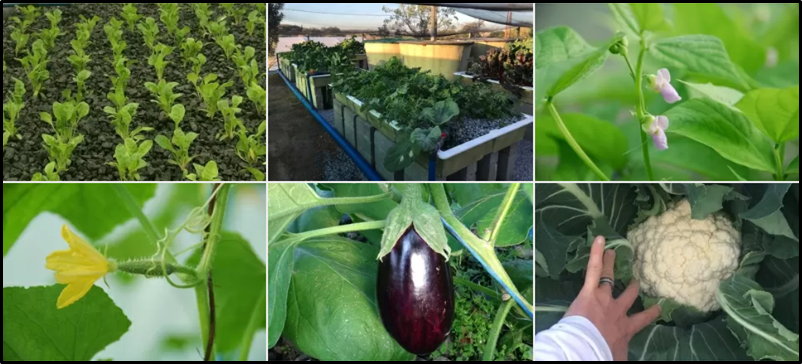
Due to the completely natural processes and reduced stress experienced by plants growing in aquaponics, pest problems are limited and only the very gentle green label pesticides (all organically certified) are required to control these bugs. This combined with the improved flavours found in aquaponics crops makes them both healthy and delicious to eat, hence the name Living Larder.
Whether you want to establish a business producing high quality, healthy, tasty crops for discerning customers or if you just wish to enjoying growing for your own needs, allow Aquaculture Solutions to show you how to best harness the wonders of aquaponics.
The first Living Larders have been operational for 10 years on the same water without any water being dumped. Water removed from the system when harvesting crops and fish is replaced with new water and Aquaculture Solutions supplied tilapia, trout, cucumbers, lettuce and mixed salad greens to supermarkets and restaurants.
Follow the link below to view the videos we have made on our favourite subject. Each video takes hours to prepare, shoot and edit, and they are offered as a free service. If you enjoy them please subscribe to our channel and select the `like’ button.
We offer a range of fish farming equipment for sale. These are items that we use ourselves and find to be suitable, reliable and cost-effective. When we design and erect fish farms these items are supplied to those facilities as we have the confidence to endorse them.
 To make an enquiry and/or to obtain a quotation, please contact us.

In the summer of 1990, after working as a skipper on a commercial fishing vessel, Leslie enrolled at Rhodes University where, in 1995, he graduated with an MSc Ichthyology. He then followed his dream and became a commercial fish farmer. Over the next 30 years he perfected his expertise while he designed, built and managed fish farms and aquaponics systems, and trained people to operate these farms optimally. He has worked across much of sub-Saharan Africa, the Indian Ocean islands and up into Eastern Europe.
Aquaculture Solutions is a pivot away from pure fish farming into Aquaponics, food security and blue carbon solutions to the overpopulation, food shortage and climate crisis. The first successful commercial aquaponics facility in South Africa was designed, erected and managed by Leslie in 2012, and eventually sold in 2021. He continues to innovate, transforming traditional aquaculture into nutritious, ecologically sound, beautiful answers to some of the most challenging dilemmas facing modern society.
Leslie is a proud father and a passionate fisherman. He values integrity, relationship, quality and professional excellence, and gets satisfaction from finding the perfect niche solution to each client’s unique conundrum.
Leslie was the founding chair of both the Aquaponics Association of Southern Africa as well as the Catfish Growers Association of South Africa. In addition, he served for many years on the committee of the Aquaculture Association of Southern Africa and AquaSA.
Leslie Ter Morshuizen
Mobile/WhatsApp: +27 834 060 208
Email: leslie@aquaculturesolutions.org
 TodayDay Off!
 Your request has been submitted successfully.


 Own or work here?